Lab 13.3: Digital Data Forensic Techniques
CompTIA Security+ Module 13
Overview
This lab focused on how digital evidence is identified, preserved, collected, analyzed, and presented in a way that supports investigations and legal requirements. I learned how forensic best practices protect evidence integrity, strengthen non-repudiation, and make forensic work useful in both on-premises and cloud environments.
What I Learned
Evidence Handling
How legal hold, chain of custody, preservation, and documentation keep evidence reliable and defensible.
Data Acquisition
How to capture system images, logs, network traffic, hashes, screenshots, and witness statements for analysis.
Integrity & Recovery
How hashing, snapshots, data provenance, and recovery workflows help prove evidence has not been altered.
Cloud Forensics
Why cloud investigations add legal, jurisdictional, and chain-of-custody challenges that differ from on-premises analysis.
Core Topics I Can Explain Confidently
Forensic Process & Evidence Control
- •Identification, preservation, collection, examination, analysis, presentation, and decision
- •Legal hold and chain of custody requirements for admissible evidence
- •Order of volatility and why volatile evidence must be collected first
- •Bit-level imaging, hashes, and preservation of the source image
Analysis, Recovery, and Intelligence
- •Hashing methods such as MD5, SHA, HMAC, and digital signatures
- •Evidence recovery from deleted space, cache files, and accessible disk space
- •Non-repudiation and how public-key cryptography supports attribution
- •Strategic intelligence and counterintelligence gathering for investigations
Exercise Summary
Motive, Opportunity, and Means
I learned how investigators build context around an incident by asking who benefited, where the event occurred, and what method was used.
Documentation and Acquisition
I studied how to document evidence correctly and how to acquire data from images, logs, screenshots, and network activity without breaking integrity.
Cloud, Recovery, and E-Discovery
I learned how cloud investigations differ from on-premises work and how e-discovery supports legal review and structured evidence handling.
E-Discovery Reference Model
This model shows the 8-step EDRM workflow used to manage electronically stored information during an investigation.
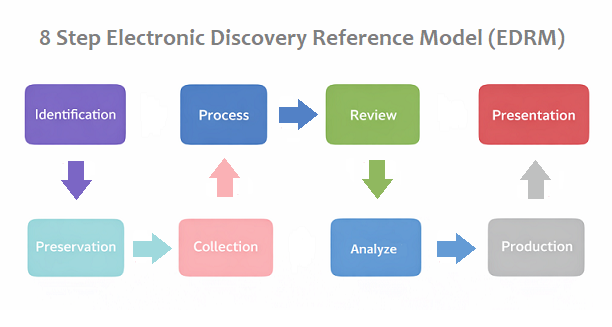
Identification, Preservation, Collection, Process, Review, Analyze, Production, Presentation
How This Advanced My Cybersecurity Learning
Evidence Discipline
This lab taught me how to protect evidence from the moment it is identified, which is essential for investigations and incident response.
Analytical Process
I now understand the importance of moving from collection to analysis in a structured way so conclusions are defensible and useful.
Broader Security Thinking
The module connected technical evidence handling with legal, organizational, and cloud considerations, which mirrors real-world security work.
Professional Value
- Stronger investigative mindset: I learned to treat evidence carefully, verify integrity, and preserve the chain of custody.
- Better legal awareness: I now understand how e-discovery, legal hold, and breach notification requirements affect forensic work.
- More complete technical analysis: I can connect disk, network, cloud, and memory-related evidence into one investigation flow.
- Clearer documentation habits: The lab reinforced the value of timestamps, hashes, provenance, and standardized evidence labeling.
- Recruiter-ready perspective: This project shows that I can handle evidence-driven analysis with precision, consistency, and attention to process.
Security+ Alignment
This lab supports Security+ Objective 4.5 by focusing on the key aspects of digital forensics and evidence handling.
Evidence Handling
- Documentation and chain of custody
- Preservation and legal hold
- Integrity verification
Acquisition and Recovery
- System imaging and network logs
- Order of volatility
- Data recovery methods
Governance and Analysis
- Cloud and on-premises differences
- Non-repudiation
- E-discovery and presentation